Our 7-Hydroxymitragynine Testing Standards
Where do we send our 7OH Powder & 7-Hydroxymitragynine Products?
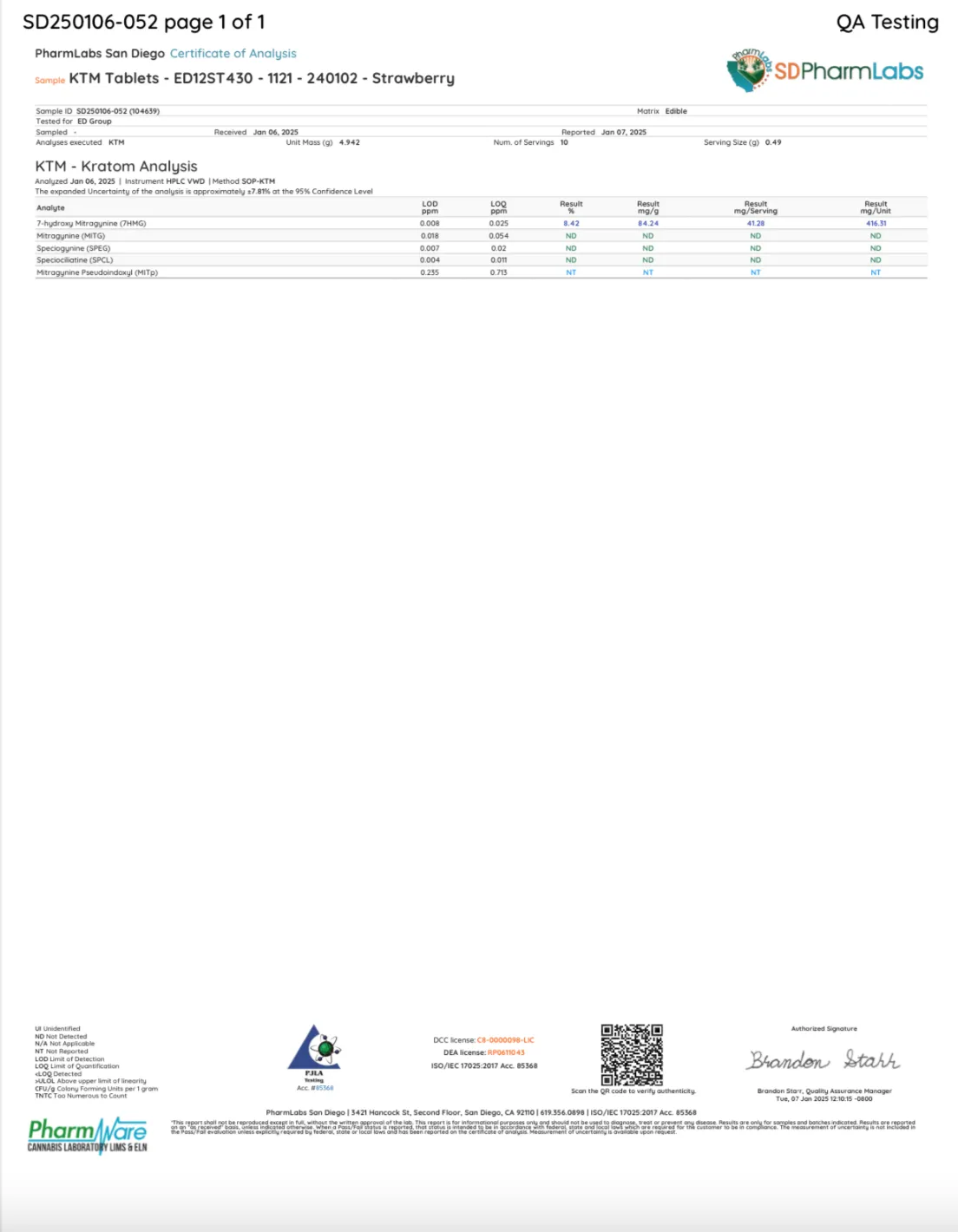
We send our powders not only to NN and SD Pharma but also to Renegade, which meticulously guarantees that all products are free from solvents. There are percentage testing discrepancies among vendors, particularly between NN/SD and Cora/Murray Brown/Renegade, due to varying testing standards. NN/SD typically tests within a range of plus or minus 10% found by Renegade, Cora, and Murray Brown. It is crucial to understand that as a vendor, our responsibility is to send each product to independent laboratories for impartial evaluation. Unfortunately, since 7OH and kratom alkaloids are relatively new areas of testing, not all third-party labs yield consistent results.
Our 3-Lab Verification Process
The Critical Role of Third-Party Lab Testing
Third-party laboratory testing is fundamental for ensuring product quality and safety when it comes to MIT and 7-OH products. Unlike internal testing, third-party labs provide unbiased, independent verification of product contents and purity.
Understanding Certificates of Analysis (CoA)
A Certificate of Analysis is a crucial document that provides detailed test results. When reviewing a CoA, look for:
- Testing laboratory’s name and contact information
- Batch number matching the product
- Recent test date
- Detailed breakdown of alkaloid content
- Pass/fail results for all safety tests
- Testing methodology used
Red Flags in Product Testing
- Missing or outdated CoAs
- Incomplete test results
- Internal testing only (without third-party verification)
- Inconsistent results between batches
- Unusually high alkaloid content claims
Regular third-party testing helps maintain product consistency and safety standards, particularly for products containing MIT and 7-hydroxy compounds. This testing is essential for verifying natural alkaloid ratios, ensuring product purity, maintaining quality control standards, and building consumer trust through transparency.
Understanding 7-Hydroxymitragynine
7-hydroxymitragynine (7-OH) is a naturally occurring compound found in kratom leaves. It forms when the body processes mitragynine (MIT), the primary alkaloid in kratom. This transformation happens through natural metabolic processes in the liver, specifically through enzymes called cytochrome P450 3A.
In its natural state, 7-hydroxymitragynine appears in very small quantities within the plant. The compound has gained attention in scientific research due to its unique properties and relationship with MIT.
Key Differences Between 7OH and MIT
- 1MIT comprises approximately two-thirds of kratom’s total alkaloid content
- 7-hydroxymitragynine, while present in smaller amounts, demonstrates different properties than MIT
- The body’s natural processes convert some MIT into 7-OH during metabolism
- The transformation occurs primarily in the liver through specific enzymatic pathways